
Realgy Energy Services Announces June–July 2026 Billing Adjustment
Realgy Energy Services is committed to keeping customers informed about their energy supply charges.
As part of our routine reconciliation process, Realgy has completed a true-up of energy settlement costs for certain Ameren and ComEd customers whose billing periods included June and July 2026.
The electricity supply rates originally used for these billing periods were based on the preliminary settlement costs available at the time of billing. Once the energy settlement process was completed and reconciled, the final settlement costs differed from the preliminary amounts previously reflected on certain customer bills.
As a result, Realgy is applying a one-time billing adjustment to reconcile the previously billed supply charges with the finalized energy settlement costs for the affected June–July 2026 period. Not all Realgy customers are impacted by this adjustment.
For impacted customers, the adjustment will appear as a separate line item on an upcoming bill labeled:
June–July26 True Up Adj
If the total adjustment is $200 or less, it will be applied in one billing cycle. If the total adjustment is more than $200, it will be divided across two billing cycles.
This adjustment applies only to the June–July 2026 billing period. It does not represent a change to a customer’s current Realgy energy supply service, current supply rate, or contract terms.
Customers with questions about this adjustment, the affected billing period, or the related settlement calculation are encouraged to contact Realgy Energy Services. Our team will be happy to provide additional information and relevant supporting documentation.
860-233-2270
support@realgy.com

Illinois Lawmakers Continue to Address Electric Issues
Illinois continues to address the energy and environmental issues affecting the State.
Previously, the clean energy transition was enacted, which has caused solar and wind investment in the State to provide clean power and jobs. The Trump administration undermined this effort by rescinding the legislation and funding to support some of the incentives.
However, data centers and the forecast for energy and related demand have created additional challenges. Think of demand as the pump or hydrant and the water as the electricity. The bigger the pump, the more water it can shoot out. Illinois customers have experienced several cost impacts this summer. Early in the spring, demand prices increased dramatically. Following the analogy, the corresponding electricity increased during the summer months.
To address this issue in a timely and environmental manner, a combination of State utilities, regulators, politicians, and environmental groups crafted a solution: energy storage with batteries. Think of a large back-up battery. Initial funding will be on electric customers; however, they will receive revenue from the expected demand markets, greatly reducing their initial investment.
The electric and demand markets, while previously separate, have both felt the financial pressure of the increases demanded by AI/data centers. The legislation named the Clean and Reliable Grid Affordability Act, or CRGA, aims to have batteries installed wherever solar power can charge them. The batteries can be discharged to provide power when grid demand is the highest. This kind of investment is very economical as it is distributed; most battery systems will be the size of a small refrigerator, and they can operate after a day’s installation.
The CRGA will allow for solar energy to be stored and used to offset peak demand. Clean, free energy that will allow the initial investment to be paid back.
Realgy Energy Services is a registered Retail Energy Marketer serving commercial customers in the states of Illinois, and Indiana. We offer Service Plans that will provide electric and natural gas at wholesale pricing direct to customers without any utility markup. Our Service Plans work with the local utility to provide seamless service and annual energy savings. Service Plans include Guaranteed SavingsTM, ManagedPriceTM, ManagedGreenTM Index, Fixed and PriceAssuranceTM.
Realgy owns and operates 11 solar plants in Illinois and is looking to invest in additional locations. Now 12 with the inclusion of Highland Park, our newest West Ridge Recreation Center – New Community Recreation Facility Coming in 2026 | Park District of Highland Park
Additional Information:

Energy Alert – Illinois Wholesale Electricity Prices Have Increased
July 21, 2026
Market update
Since late June, wholesale electricity prices in Illinois have reached roughly three times their previous levels and early July is headed in the same direction or above. Because your account is on a variable-rate plan that follows the wholesale market in real time, these higher costs are already showing up in the supply portion of your electric bill.
Why prices increased
The increase is being driven by higher wholesale market costs during a period of extreme summer demand. Across the Midwest, extreme heat, record electricity demand, and unplanned power plant outages have put added stress on the grid, forcing operators to rely on more expensive generation and contributing to higher wholesale.
To maintain reliability during these conditions, grid operators also must secure enough available generation capacity, which adds to overall supply costs. As a result, both energy and capacity costs have moved higher.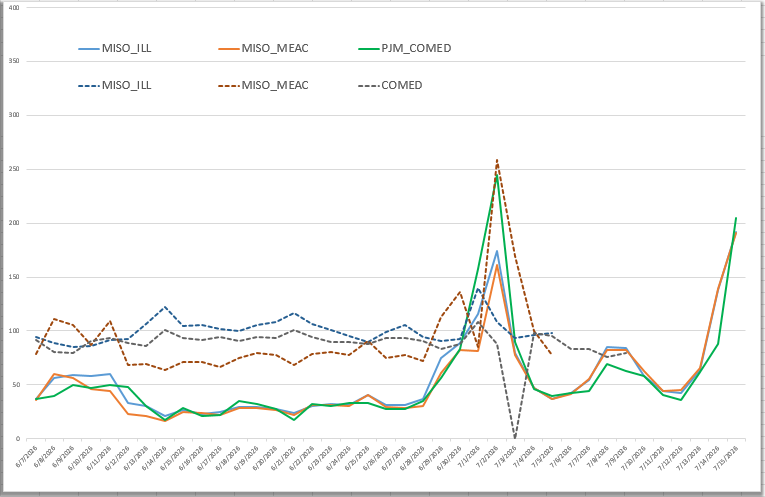
How your rate responds
With a variable-rate product that reflects the wholesale market in real time, these market increases are already being reflected in your bill. When wholesale prices move up, your rate moves up; when wholesale prices come down, your rate can respond more quickly in that direction as well.
Our variable rate is designed to pass through market costs as they change. Our margin over the wholesale market has not changed, and these increases are not the result of any additional mark-up.
How this differs from utility pricing
Utilities recover these same market costs later, through their next rate change. In general, utilities estimate future supply costs and expected customer usage, then later “true-up” the difference between forecasted and actual costs through a future adjustment.
How you can respond
- Use our Service Match program. If you find a lower fixed rate offered by another licensed third-party energy supplier, bring us the rate along with the offer’s terms and conditions and we will match that fixed rate for you.
- Review your recent bills and contact us if you would like help understanding how your variable rate is calculated and how market changes appear on your statement.
- Take steps to reduce or shift usage away from peak hours, such as slightly raising your thermostat, delaying laundry or dishwashing, and turning off non-essential lighting and equipment.
This market movement is affecting electricity costs across the region, and Illinois has been part of that broader price volatility. The goal is to keep customers informed, explain why these increases are happening, and provide options to help manage energy costs.